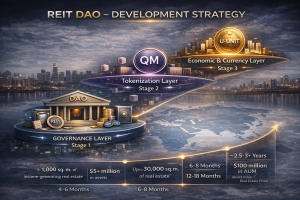
REIT DAO is developed with a primary focus on control and long-term resilience. Each stage is launched only after legal and operational readiness has been fully validated.
- Phased Development. All stages are introduced sequentially and under controlled conditions.
- Governance Before Scale. Governance and oversight are established prior to expansion.
- Robust Legal Architecture. The structure is optimized for capital protection, asset control, and regulatory resilience.
- Real Assets → Real Utilization. Economic activity is driven by rental operations and infrastructure services.
STAGE 1 — Governance Layer
Establishing the Governance and Legal Foundation
Token: REPU (Reputation / Participation Unit)
Role: governance, control, strategic decision-making
Cash flow: USDT / USDC → DAO Treasury
Stage Overview
At this stage, REIT DAO is established as a governance and coordination structure that enables:
- collective decision-making through on-chain governance,
- formation of the DAO treasury,
- a legally sound framework for asset ownership and management,
- acquisition of the first income-generating real estate assets through SPVs.
Participants
- founders’ circle,
- early contributors,
- strategic supporters.
Role and Meaning of REPU
REPU is a governance token that reflects the level of participation in the DAO.
It represents a participant’s contribution to the project, including capital, expertise, and organizational or operational involvement.
REPU is used exclusively within governance processes.
DAO Activities
The DAO:
- accumulates funds in the DAO Treasury,
- allocates funds strictly through collective governance votes to:
- acquire real estate assets via SPVs,
- cover legal and operational expenses,
- develop the DAO ecosystem infrastructure.
Stage 1 Outcome
- the DAO is legally and operationally launched,
- key rules and decisions are recorded on-chain,
- treasury management is fully governed through DAO voting,
- SPVs are established and the first hotel / luxury income real estate assets are acquired.
Stage benchmarks:
- at least 1,000 sq. m of income-generating real estate,
- estimated asset value of $5+ million,
- base operating income from rental and management of 8–10% per year.
Planned duration: 4–6 months
STAGE 2 — Tokenization Layer
Scaling the Real Estate Pool and Participation Model
Token: QM (QuadMeter Token)
Role: participation, accounting, ecosystem scaling
Cash flows: USDT / USDC → QM, REPU → QM
Stage Overview
At this stage, the DAO transitions to a scalable participation model and opens access to an international pool of income-generating real estate managed by REIT DAO.
QM Logic
QM is a unit for measuring the total volume of real estate under DAO management.
Real estate assets are accounted for in square meters as a universal measure of scale, regardless of location or individual asset value.
QM is used as an accounting unit for participation in the economic results of the asset pool.
QM does not represent a specific asset or a portion of an asset and does not convey ownership rights. It is used solely to account for participation in the aggregate asset pool of the DAO.
Economic Participation Logic
- 8–10% is generated from operating income through rental and asset management,
- additional economic results arise from real estate value appreciation and pool scaling,
- these results are realized upon exit, rather than through fixed periodic payouts.
Asset Pool Scaling
Growth of DAO assets is achieved through two channels:
- acquisition of real estate assets via SPVs,
- contribution of existing real estate into the DAO-managed pool (in-kind contribution), where asset owners transfer properties into the fund structure and receive REPU as participation weight.
Stage Infrastructure
- launch of the REIT DAO platform with optimized UX,
- expansion of the governance model,
- development of legal and operational infrastructure,
- integration of real estate assets into the DAO pool through SPVs.
Stage 2 Outcome
- an operational REIT DAO platform,
- a scalable pool of income-generating real estate,
- a structured participation and exit model.
Benchmarks (cumulative from project launch):
- up to 30,000 sq. m of real estate under management,
- estimated asset value of up to $150 million,
- target horizon: 12–18 months from project launch.
Planned stage duration: 6–8 months (after Stage 1)
STAGE 3 — Economic & Currency Layer
Formation of the DAO Internal Economy
Settlement unit: U-Unit
Role: payments, services, internal DAO economy
Cash flows:
U-Unit ← tenants, partners, users
U-Unit → DAO Treasury
Stage Overview
At this stage, REIT DAO forms a closed internal economic model in which:
- real estate assets generate stable real economic demand,
- the settlement unit is used for operations and services within the ecosystem.
U-Unit Logic
U-Unit is an internal settlement unit of the DAO, with its rate determined algorithmically based on asset value and demand within the ecosystem.
Areas of Use
U-Unit is used for:
- rental payments for DAO assets,
- ecosystem fees and services,
- operations involving QM,
- incentive and reward programs,
- future DAO services and marketplace activities,
- real estate-related operations (loans, collateralization, buyouts, and RWA investments).
Stage 3 Outcome
- a functioning internal DAO economy,
- liquidity growth driven by real real estate usage,
- readiness for engagement with institutional partners,
- scalable infrastructure for long-term growth.
Final cumulative benchmark (across all stages):
- $100 million — value of assets / real estate pool under DAO management (AUM),
- target horizon: approximately 2.5–3+ years from project launch.
Planned stage duration: 18–20 months