The project is built on a multi-layer legal and governance model:
DAO Participants → DAO (Governance Layer) → DAO Fund (Treasury) → SPVs (Multiple Jurisdictions) → Real Estate Assets
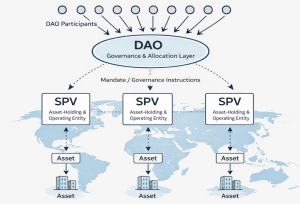
The model is based on well-established legal structures widely used in international real estate structuring, investment funds, and Real-World Assets (RWA), including the use of SPVs, mandate agreements, and separation of asset ownership and management.
The project’s innovation lies not in creating new legal forms, but in the systematic integration of proven legal instruments into a single architecture, using a DAO as a decentralized governance and control layer.
DAO — Governance Layer
(Decentralized strategic control framework)
The DAO operates as a cross-jurisdictional governance layer, responsible for strategy, capital allocation, and distribution rules.
Key characteristics:
- all key decisions are made collectively through governance voting;
- decisions are recorded on-chain, ensuring transparency, verifiability, and immutability;
- the DAO defines and approves binding mandates under which all lower levels of the structure operate.
DAO Fund — Treasury
(Capital accumulation and distribution layer)
The DAO Fund represents the DAO’s treasury, through which all financial flows of the project pass.
The DAO Fund:
- accumulates contributions from participants;
- executes direct payments to property sellers for asset acquisitions;
- receives proceeds from SPVs;
- distributes funds exclusively based on collective DAO decisions.
To ensure maximum security:
- multisig mechanisms are used;
- unilateral control over funds is eliminated;
- every fund movement is linked to an approved governance decision.
SPVs — Legal Holders of Real Estate
(Special Purpose Vehicles)
Each real estate asset is held by a dedicated SPV incorporated in the relevant jurisdiction.
It is critically important that:
The DAO acts as the legitimate economic and governance beneficiary of the real estate.
The SPV legal structure and mandate agreements are designed so that:
- SPVs are the legal owners of the real estate assets;
- any actions involving the assets (sale, pledge, refinancing, change of use):
- are possible only with an approved DAO decision;
- cannot be executed unilaterally by SPV management or third parties.
As a result, the DAO:
- controls assets through rules and mandates,
- while remaining legally separated from direct property ownership for regulators and supervisory authorities.
Economic Participation and Investor Protection
Within this model, DAO participants:
- indirectly hold economic exposure to real estate through the DAO → SPV structure;
- indirectly participate in asset management via governance mechanisms;
- are the ultimate economic beneficiaries.
At the same time, they:
- are legally insulated from direct asset ownership;
- are not subject to regimes governing individual ownership of foreign real estate;
- are protected from:
- country-specific regulatory risks;
- changes in local property ownership laws;
- personal obligations related to holding assets in foreign jurisdictions.
Implications for Large Investors
For larger investors, this structure provides:
- an institutional level of protection;
- reduced compliance and administrative burden;
- the ability to scale across multiple countries without changing the core structure.
Overall Model Logic
This architecture combines:
- proven legal instruments (SPVs, mandates, role separation);
- a modern DAO-based governance and control model;
- jurisdictional diversification and capital protection.
The model enables economic participation and control over real estate while maintaining legal separation from the risks of direct asset ownership.