 Web3 solutions for on-chain real estate management
A DAO (Decentralized Autonomous Organization) is a governance model where decisions are made collectively, based on predefined rules, and recorded on-chain.
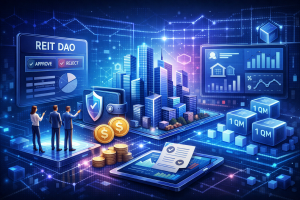
In REIT DAO, this is not a concept or experiment — it is the core operating layer for capital control, deal approval, and real estate management.
From day one, our DAO is deployed on Aragon, a proven and widely used on-chain governance framework.
How this is implemented in our project (step by step)
1. DAO governance & REPU
Governance is powered by the REPU token, which is used for:
- voting on key decisions,
- approving acquisitions and transactions,
- setting and adjusting governance parameters.
All decisions are executed and permanently recorded on-chain.
2. Treasury protection & crypto settlements
The DAO treasury operates via multisig wallets:
- no single-party control,
- transactions require collective approval,
- every action is on-chain and auditable.
Crypto settlements (USDT / USDC) are used to:
- ensure liquidity,
- enable fast cross-border capital movement,
- remove banking friction.
At the same time, the project operates under full KYC / AML compliance, with legal SPV structures for asset ownership and fiat income flows.
3. On-chain real estate reporting
We build an on-chain data layer for real estate assets, including:
- ownership and SPV status,
- DAO-approved decisions,
- liquidity indicators,
- income distributions and key performance metrics.
This provides real-time, verifiable online information about the portfolio.
4. Tokenization & QM (square meter units)
At the next stage, assets are tokenized using the QM (Square Meter Units) model:
- real estate is represented as digital square meters,
- entry barriers are reduced,
- liquidity is increased,
- access is expanded beyond traditional investors.
Tokenization is activated after portfolio formation and operational stabilization.
Summary
REIT DAO implements Web3 gradually and pragmatically:
- DAO governance and REPU — from day one,
- multisig treasury and crypto liquidity — immediately,
- on-chain reporting — as the portfolio grows,
- QM tokenization — as a scaling layer.
This is infrastructure where governance, capital, and real estate are connected at the code and legal level, not by promises.