Real estate has long been considered the ultimate safe haven. However, in 2025–2026, we are witnessing a systemic failure in the world’s largest investment vehicles: Open-Ended Real Estate Funds.
The problem isn’t the brick-and-mortar; it’s a fundamental architectural flaw in the financial model governing trillions of dollars.
The Scale of the Crisis (2025–2026 Data)
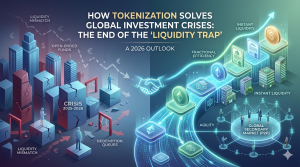
The Liquidity Mismatch—promising instant exits while holding illiquid assets—has finally reached a breaking point. The numbers tell a sobering story:
- Germany: Net outflows hit €7.6 billion in 2025 alone. Major funds like Greenman Open and Fokus Wohnen have been forced to implement Redemption Gates, trapping investor capital indefinitely.
- Switzerland: Even the giants aren’t immune. UBS Euroinvest (with assets ~€406M) confirmed a 3-year suspension of redemptions in March 2026.
- USA: Redemption queues for private REITs and open-ended funds have surged past $50 billion. Investors are being “drip-fed” their own capital, often limited to 2–5% of their holdings per month.
- Canada: Major managers slashed NAV (Net Asset Values) by 15–20% overnight in late 2025 to curb the tidal wave of withdrawal requests.
The Diagnosis
When a fund must sell a skyscraper to pay back a $10,000 retail investor, the model is broken.
In a downturn, the manager’s only real tool is a Lockdown.
Enter Tokenization: The Cure for Systemic Stagnation
Asset tokenization is far more than blockchain hype; it is the technological solution to the absence of a secondary market.
Here is how it fundamentally rewrites the rules:
1. Secondary Market Liquidity (P2P)
Currently, your only exit is the fund’s treasury. If they are out of cash, you are stuck.
Tokenization allows investors to trade shares directly with one another 24/7. Liquidity is provided by the global market, not the manager’s balance sheet.
2. Fractional Efficiency
Real estate is inherently illiquid and “lumpy.”
Tokenization breaks a building into millions of digital units. This allows investors to liquidate 1–2% of an asset to meet immediate cash needs without triggering a fire sale of the entire property.
3. Instant Collateralization
In the 2026 financial ecosystem, a tokenized property share becomes high-quality collateral.
Investors can access liquidity via DeFi or fintech protocols, retaining ownership and rental yield while unlocking capital instantly.
The Paradigm Shift: From Control to Freedom
Today, when markets decline, fund managers invoke “investor protection”—freezing withdrawals—while continuing to collect management fees.
The investor ultimately pays for the manager’s inability to forecast outflows.
Tokenization changes this dynamic:
- Transparency: Real-time on-chain auditing replaces quarterly reports
- Agility: Exiting a position takes minutes, not years
- Independence: Liquidity no longer depends on a fund’s cash reserves
The Bottom Line
Every global cycle—2008, 2020, and now 2026—demonstrates the same truth:
Paper-based ownership of real estate is structurally outdated.
Tokenization is not an evolution—it is a shift in financial infrastructure.
It transforms capital locked in physical assets into something fluid, tradable, and resilient.
Final Thought
The future belongs to those who demand liquidity
by right of ownership — not by permission of the fund.